From the evening of Wednesday 02 September through to the early afternoon of Friday 04 September, the PresentDead project hosted a conference centered primarily on textual accounts of grave re-openings and interactions with the dead spanning the medieval world. It was, it’s fair to say, an unmitigated success, reflected in an overall joyous and rewarding feeling and the lovely feedback from our participants. In total we brought thirteen academics at various stages of their careers, from doctoral students to professors to Graz (most in person, some digitally) to present on how interactions with the dead appeared within their own research, with the aim of understanding the broadest scope of how people in Late Antiquity and across the Middle Ages imagined and wrote about such interactions. This was ostensibly a follow on from the preliminary hybrid workshop we held here in November last year, with some familiar faces returning. Although, the overall line up changed significantly as many of the original participants had clashes for the new event, while several new people responded to the call for papers—or were encountered in and around this year’s IMC , and were happily ‘press-ganged’ into joining us.
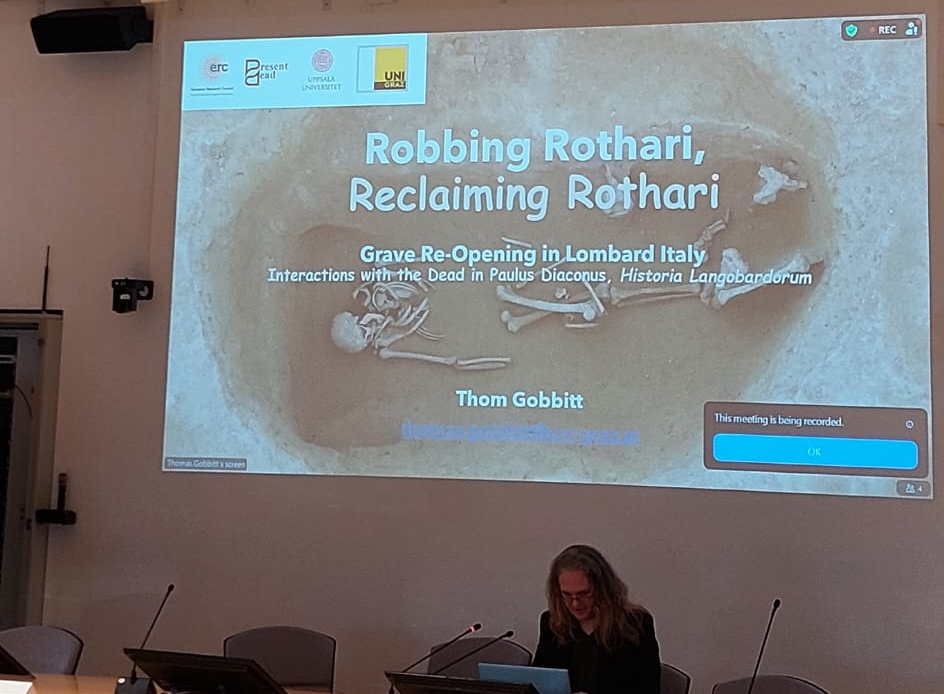
We began on Wednesday evening, with a keynote by myself, in which I dove into the language of Paul the Deacon’s late-eighth-century Historia Langobardorum [History of the Lombards] in his account of the robbing of the grave of King Rothari (d. 652), and the saintly retribution that followed. I also took the chance to contextualise the account, with a quantitative survey of interactions with the dead across the Historia, and a “compare and contrast” style study of grave robbing as presented in the Lombard laws issued in the name of the same king. That was followed by a wine reception, and a lot of chatting and getting to know each other.
Over the next day and a half, following an introduction to the PresentDead project from our PI, Edeltraud Aspöck, the speakers presented across five sessions, starting with Chris White, Bruno Schalekamp and Clemens Gantner taking us from stories of the supernatural through grave robbing and theft in early medieval canon law to the unearthing of Pope Formosus and the Cadaver synod. In the next session Friedrich Becher and Samantha Sandy brought us to bodies (unfortunately Inès Limam had to withdraw), from the exhibition of the dead and the seen or unseen body to accounts of the miracles of the “astonishing”, thrice dead and twice resurrected Christina mirabilis. In session three Alex Năchescu, James Baillie and Gunhyuk Lee opened up the view across the late antique and medieval world, with studies ranging from the reburial in northern China in the fifth and sixth centuries, to the opening of tombs in late medieval Persian and Caucasian literature through to prosphoria and memorial practices in late antique Egypt. Our Thursday then ended with a meal out for the speakers, and again with much chatter (and possibly disturbed people on neighbouring tables as our over-dinner conversation inevitably turned and returned to the reopening of graves). Friday morning had two sessions, beginning with Crystal Hollis and Josip Parat discussing graffiti and epigraphy, from post-medieval people writing themselves onto medieval tombs and churches to late antique inscriptions commemorating the dead in Roman Dalmatia. Finally, the conference concluded in early medieval historiography, with Francesco Veronese and Michaela Selway examining accounts of interactions with and judgements of the dead in Paul the Deacon’s Historia and Gregory of Tours Gloria Martyrum.
The decision was made at the planning stage to include a bit more time than usual for discussion, in the certain knowledge that re-opening graves and interacting with dead bodies always gets the conversation and questions flowing. If anything, however, we still didn’t schedule enough time. Fortunately, however, the end of the conference does not mark the end of this thread of the project: the next steps will be preparing an edited collection based on the presented papers—and if you missed the conference but have an appropriate article underway and looking for a home, please do send me an email [thomas.gobbitt(at)uni-graz.at] with a title, abstract and biography as soon as possible!