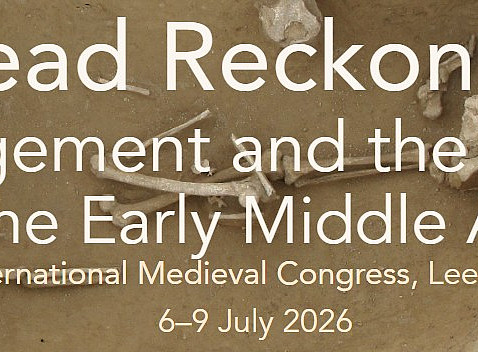
The PresentDead at the International Medieval Congress
From Monday 6th to Thursday 9th July 2026, the project historian (Thom), was at the International Medieval Congress (IMC), an annual conference of all manner of medievalists, held in Leeds, UK. I always appreciate going back to the IMC, as it’s the university where I did my doctorate, and inevitably a chance to bump into old friends and colleagues and—with over 2500 people attending—meet new ones. Included amongst those were a few other people also interested in grave re-opening and interactions with the dead, including a Carolingist with a focus on capitularies and church councils, a hagiologist of the Central and Late Míddle Ages with an interest on a Saint who comes back to life in her grave, and a Sinologist focusing on grave re-openings and ancestral cults in fifth century China. Needless to say, each was extended a last-minute invite to our forthcoming conference to be held in Graz this September (the deadline has passed, but here’s the [CFP https://presentdead.uni-graz.at/de/neuigkeiten/blogpost-10-10032026/]), and resultant Edited Collection, although both are stories for future blogposts!
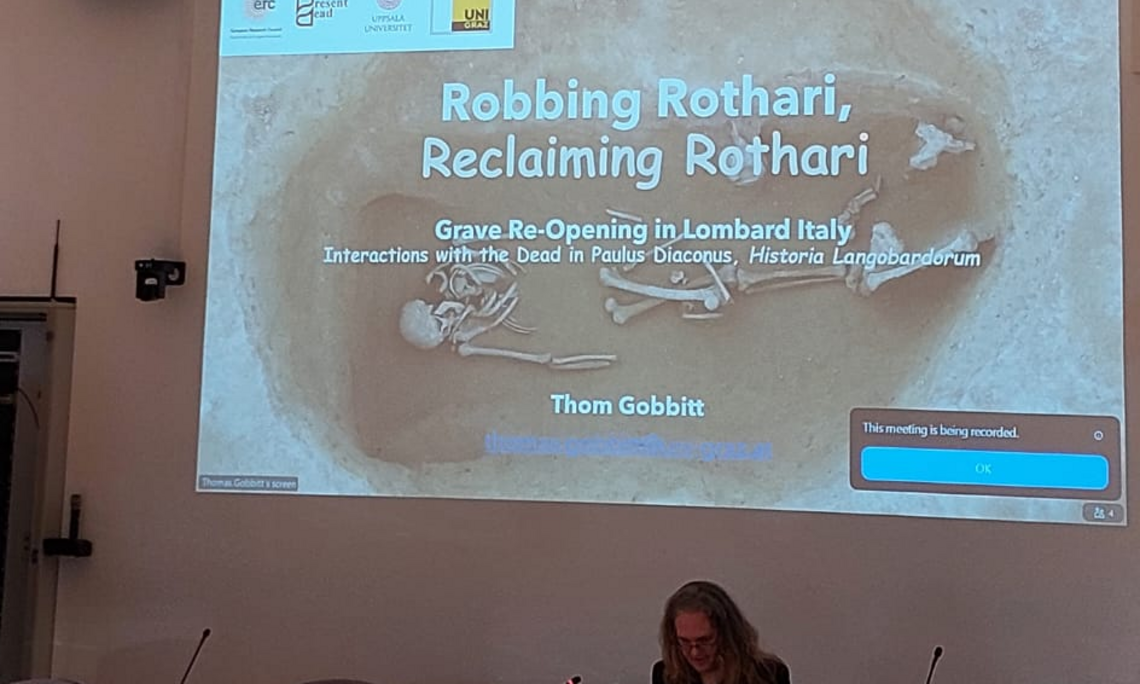
For the IMC conference this summer, Thom and Michaela Selway—a doctoral student at the Universität Tübingen who has just submitted her PhD thesis—co-organised a session on grave re-opening and judging the dead in the Early Middle Ages, which brought together three papers. The session was very well attended, drawing a crowd of some twenty or thirty attendees and drawing a witty observation from one, that it was a surprising delight that a session on the dead was so lively! The presenters, including myself, comprised familiar faces from the PresentDead’s hybrid workshop on historical texts, which we held in November 2025. Moreover, it offered a chance for us all to meet in person, as previously the two other presenters had only been there digitally. Michaela began by presenting her research on Gregory of Tours and Merovingian Francia, offering a narratological analysis of two miracles in which the dead were resolutely punished in their graves for their sins in life, and tying the accounts to biblical exemplars. Jake Stattel, a postdoctoral researcher at the University of Cambridge, then followed, taking us to the border of England and the ‘Danelaw’ in the tenth century, and investigating what can actually be seen of early medieval Scandinavian laws and customs through the eyes of English law-codes, with a close focus on the wargus [outlaw, ‘wolf’?] and emphasising the need for caution when comparing the term to its manifestations in later English and Scandinavian laws. Finally, Thom concluded the session with a close look at the burial, re-opening and robbing of Rothari, King of the Lombards as recounted in Paul the Deacon’s History of the Lombards, examining the emotive language employed to tell the audience how they should feel about this re-opening—and hinting at comparative study of the accounts of other re-openings in the History, and at the legal framework of the Lombard laws, to which he will return in the coming months.
I am delighted to say that each of these papers are also promised for expansion in the project’s proposed Edited Collection. Moreover, while a research trip means that Jake cannot make it to Graz this autumn, we are looking forward to meeting Michaela once more and hearing even more about her research, and the research of the other presenters—some hinted at previously, some who attended the earlier workshop, and many who responded valiantly to the call for papers with exciting research proposals of their own! While I am looking forward to September already, I should conclude with the remainder of the IMC: After our session on Tuesday morning concluded we all went our separate ways, but inevitably bumped into each other over the coming days. While there were no other sessions dedicated entirely to grave re-opening, as mentioned at the outset it was pleasantly surprising how often it turned up anyway in different forms. Moreover, the conference offered an unparalleled opportunity to see such a wide range of research from scholars active across a broad range of fields and subject areas, that all manner of interconnections—subtle and overt—inevitably sprung to mind.
Thom Gobbitt