

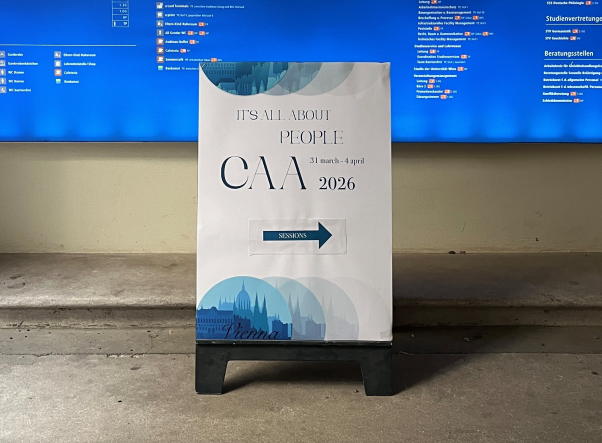
Computer Applications in Archaeology (CAA) is an international organisation that brings together archaeologists, mathematicians and computer scientists to advance digital tools in archaeology. This year’s CAA annual conference (the 53rd !) was held in Vienna. The conference drew experts, researchers, and students from around the world to discuss the latest advances in how digital tools and computational methods are shaping archaeological research.
The keynote presentation was shared between representatives of four Austrian institutions who each gave insight into research – and in the case of the Universities, also of the teaching – of digital applications in archaeology in their respective institutions: the Austrian Archaeological Institute (ÖAI), the University of Vienna, the Natural History Museum Vienna, and the University of Graz. The presentations ranged from major projects and new technologies to emerging research priorities and offered the audience a broad, comparative overview of research and teaching across Austria today. In the University of Graz segment, Edeltraud gave a dynamic overview of current teaching activities and both, ongoing and completed projects including a short presentation of the PresentDead project. This new keynote format apparently was well received, offering the CAA audience a bird’s eye view of research directions and exciting developments in the host country.
On the third day of the conference, Session 19, titled: ‘Structuring the World Beyond: Analytical and Computational Approaches towards Protohistoric and Early Medieval Funerary Data’ was diving right into the heart of the PresentDead project. The first part of the session was dedicated to analyses of mortuary evidence in a variety of contexts and regions ranging from Egypt to China applying social network analysis, machine learning and agent-based modelling. The second part of the session was dedicated to early medieval Europe, with equally diverse approaches to analysis of mortuary data.
In our presentation titled ‘Reconstructing the re-entering of early medieval inhumation graves: 3D GIS for integration and taphonomic analysis of (bio-)archaeological, environmental and geoarchaeological data from high-resolution excavations’ Laura presented on the integration and analysis of excavation data from the early medieval cemetery at Achau (a topic familiar to regular readers of this blog), which is part of her ongoing PhD research using 3D Geographic Information Systems (3D GIS). She outlined the evolution of 3D GIS technology and its growing role in archaeology, which now enables to go beyond simply visualising features with added elevation values, but to represent features as true 3D objects or 3D surfaces. This allows for highly accurate and detailed 3D representations of archaeological contexts. Laura summarised her workflow for integrating bioarchaeological and environmental data in high resolution demonstrating that preliminary results indicate that 3D GIS, especially ArcGIS Pro (which is currently the only GIS software that allows for the easy visualisation of true 3D geometries) offers an effective solution for managing complex datasets and enhances both exploratory and visual data analysis. However, in her presentation, she also addressed some current limitations: while 3D GIS environments are highly flexible for initial investigation, more advanced spatial analyses still require custom programming, often in Python. Off-the-shelf GIS solutions are progressing, but tailored approaches remain essential for research in archaeology.
Overall, CAA 2026 Vienna was a great hub to explore current developments in digital archaeology – and to no surprise many papers were dedicated to the application of AI in its many manifestations. We look forward to seeing how these dynamic collaborations and new technologies will continue to shape archaeology in the coming years!
Laura Elmer, Edeltraud Aspöck