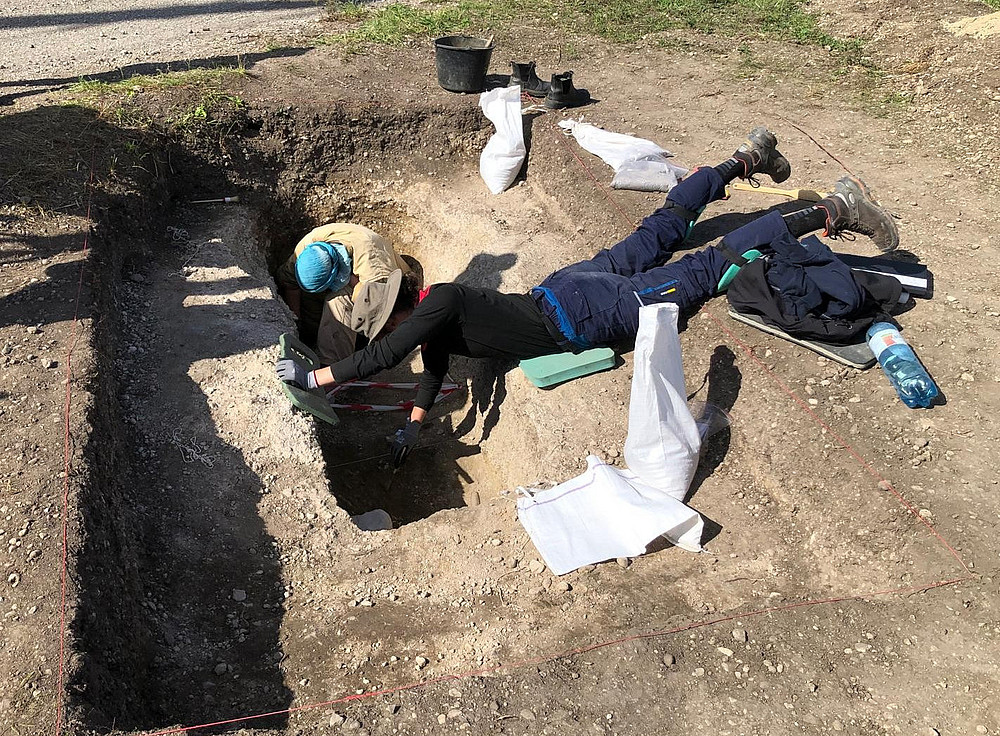
Have you ever coincidentally found a burial site? No? Well, the probability seems to be quite low, though apparently heightened when you’re trying to build something. In this case an additional train track should have been built in Achau, Lower Austria, when a cemetery of over 200 graves was rediscovered using geophysical technology.
As archaeology students of the University of Graz (and Medical University of Graz) we had the opportunity to spend two weeks at the excavation of an Avar burial ground. The participating students were split into two groups, with one group working on two graves in field and the other washing and sorting soil samples. The ones in the field worked on excavating two inhumation graves - an undisturbed one (obj. 1) and one that was re-opened after burial (obj. 3). The others spent the first week flotating the excavated soil samples to filter out any organic remains such as bone fragments and botanical remains. The remaining stones, daub and chert were also sorted and catalogued. In the second week the two groups switched locations so that the first group also had the chance to learn about flotation, and the second to continue with the excavation and its documentation.
In addition to the practical work experience we were able to learn more about the Avars and this specific cemetery due to presentations held by some of the team members. For example, two presentations by Thom Gobbitt on grave robbing, the laws and punishments of different cultural groups all over Europe. Another presentation was on Archaeothanatology and held by Eliza Orellana Gonzalez, who told us about burial contexts and what skeletons could tell us about their cultural groups. Jasmin Özyurt talked about Avar grave goods and showed us some restored pieces of the Achau excavation site.
So, all together our time here at the excavation was very interesting and educational as we learned more about working on graves, cemeteries and human remains, and different excavation and post-excavation methods for such complex sites.
Ina Flühr